
The Flex Room Addition: How to Build a Space That Works Today and Pays Off Tomorrow
Most homeowners don’t need one more bedroom. They need a room that can be a home office this year, a nursery the next, a gym after that, and a guest room whenever the in-laws visit. That flexibility is driving the fastest-growing addition request of 2026: the flex room.
It sounds simple. Just build a room and leave it open-ended. But the rooms that actually adapt over a decade aren’t the vague ones. They’re the rooms that get wired, lit, and framed from day one to change jobs without a second renovation.
What is a flex room? A flex room is a finished, intentionally undefined room built to shift between uses such as a home office, guest room, gym, playroom, or hobby studio as a household’s needs change. It’s planned around adaptability, with flexible power and lighting, a neutral layout, and the rough-ins that let it convert later without tearing into the walls.
What Counts as a Flex Room (and What Doesn’t)
The word gets thrown around loosely, and the distinctions matter both for what you’re actually building and for how buyers read it later.
| Space | What it is | Key trait |
|---|---|---|
| Flex room | A finished room built to change uses over time | Built to adapt, with no fixed function |
| Bonus room | Leftover finished space, often over a garage | Defined by location, not intent |
| Flex suite / ADU | A separate unit with its own entrance, bath, and kitchenette | A dwelling, with far heavier permitting |
Why the Label Affects Resale
A flex room and a spare bedroom can be the same four walls, but they don’t appraise or market the same way. A room only counts as a bedroom if it meets code, which typically means a closet, a window that meets egress requirements, and a heat source. Build to that standard and you keep every option open. You can list it as a bedroom, an office, or flex space, whichever the buyer wants to hear. Skip the closet or the egress window and you quietly cap what the room can be called.
The Many Lives of One Room
The reason this addition pays off is that it never goes stale. The same four walls cycle through jobs as life changes:
- Home office, the use that started the trend and still the most common
- Guest room, where a fold-down or murphy bed turns it over in seconds
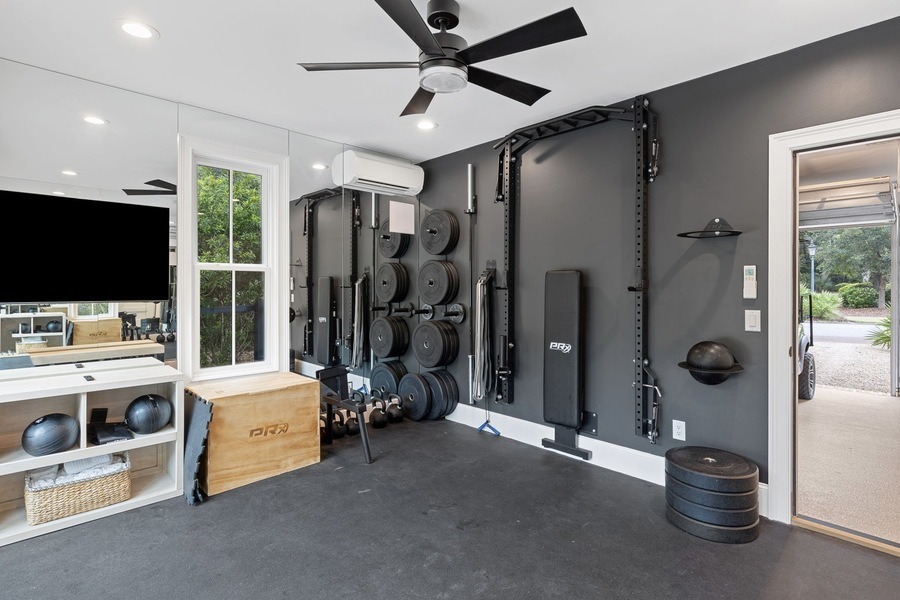
- Home gym, close to a bath and with a floor that can take the weight
- Playroom or nursery, with sightlines and storage now and a teen’s room later
- Hobby or craft studio for sewing, art, music, or painting
- Home theater or reading nook for when the kids move out and priorities shift
Design for the next use, not just the current one, and you skip the second renovation entirely.
Building a Room That Actually Adapts
This is where a real flex room separates from a plain spare room. Adaptability comes from a set of decisions made at framing and rough-in, when changing your mind is cheap.
Power and Data Where You’ll Need Them
A home office wants outlets and hardwired data at desk height on multiple walls. A gym wants a dedicated circuit for equipment. A theater wants power behind where a screen goes. Since you can’t predict the exact use, over-provision sensibly with extra outlets on more than one wall, a dedicated circuit or two, and conduit or pre-run cabling for data. Adding a circuit during a build is minor. Fishing one through a finished wall later is not.
Light, Sound, and Climate
Natural light makes a room usable for almost anything, so prioritize good window placement. Layer the artificial lighting with overhead, task, and dimmable fixtures so the same room can feel like a bright office or a dim screening room. Insulate the interior walls for sound, because a gym, a music studio, and a sleeping guest all benefit from a room that doesn’t broadcast into the rest of the house. And make sure your HVAC actually reaches it. A tacked-on room that runs ten degrees off the rest of the house gets used for storage, not living.
The Closet and Egress Question
If there’s any chance the room becomes a bedroom for a guest, a kid, or a future buyer, build in a closet and an egress-compliant window now. Both are far cheaper during framing than as a retrofit, and together they unlock the room’s most valuable identity.
Furniture and Dividers That Earn Their Keep
The build sets the stage, and the furnishings finish the job. Murphy beds, fold-away desks, and modular shelving let one room reset for a new use in an afternoon. Room dividers or a partial wall can split a single flex room into a work zone and a guest zone. None of this works if the bones aren’t there, which is why the build comes first.

Building It Right: Behind the Walls
A flex room is an addition, and additions are structural projects. The finish work is the easy part.
Structural Integration, Not a Bolt-On
A flex room has to tie into the existing home at the foundation, framing, roofline, and load paths so it reads as part of the house rather than a shed grafted onto the side. When it’s done right, the transition is seamless and the structure is sound. When it’s treated as an afterthought, you get sloping floors, cracking at the seam, and a room that always feels separate.
Permits, Egress, and What Inspectors Check
Even without a kitchen or separate entrance, a flex room addition needs permits, and inspectors will check the framing, electrical, egress, insulation, and HVAC tie-in. Egress is the one homeowners underestimate. Any room intended for sleeping needs a window or door that meets size and height minimums for escape. Scope this correctly upfront and the inspection is a formality. Guess at it and you’re reworking finished walls.
Does a Flex Room Pay Off?
Yes, and more reliably than a single-purpose addition, because its appeal doesn’t depend on the buyer wanting the exact thing you built. Buyers consistently respond to finished, adaptable square footage they can map onto their own lives.
A room marketed as flexible lets a remote worker picture an office, a growing family picture a nursery, and a downsizer picture a den, all from the same listing. That versatility is what delivers the return. The strongest value comes when the room is also built to qualify as a bedroom.
Why This Is a Contractor’s Job
A flex room looks like a simple build and isn’t. The structural tie-in, the load-bearing decisions, the electrical capacity, the HVAC extension, the egress and insulation, and the rough-ins that future-proof the space all have to be planned together and built in the right order. Roberts Construction builds flex rooms around how your household will actually use the space over the next ten years, then handles the structure, licensed electrical, and finish work to make it real.
Frequently Asked Questions
Start Your Flex Room Plan
The best flex rooms get built for a use you haven’t thought of yet. Roberts Construction builds flex room additions that adapt as your life does, structurally sound, code-compliant, and wired for whatever comes next.